Accountability
LESA took a car and never picked up the phone.
They had the email address. They used it, after the car was already gone. The reason given for no call before the tow was a contact preference on an account that was never knowingly created. Their own proof that a sign was up is the angle of a strip of masking tape.
On 23 June 2026 my car was towed from Triq Santa Marija in Mosta. There was no call, no SMS and no warning of any kind. I found out it was gone when I went to find it.
When I rang LESA to ask why I had not been contacted beforehand, I was told they did not have permission to call me. That was the explanation for taking a car without a word: a permission setting.
An account I never created
I have never knowingly created a LESA account. I have never sat down and set contact preferences with them. When I pushed on this, I was told the preference was linked to an account in my name, one I have no memory of creating. Most likely it was generated through some unrelated dealing with a government portal, where a contact setting buried in the small print carried over. Nobody signs up for a LESA account on purpose.
One email, in February 2023
There was, it turns out, exactly one attempt to involve me in any of this. A single email in February 2023, inviting me to register my contact preferences. It went straight to my junk folder and sat there unread, like most automated mail from an address you do not recognise. I was never asked again. No reminder, no second email, no letter, no call, no SMS.
So I never opted in, because I never saw the one message that asked me to. That silence, a spam-filtered email from more than three years ago, is the entire basis on which LESA decided it had my instruction not to warn me before towing my car. An agency with the power to take your property can manage more than one email in three years. If consent matters enough to justify towing in silence, it should matter enough to confirm. A message that lands in junk and is never followed up is not consent. It is a box ticked.
They had my email the whole time
Here is the part that does not hold together. LESA emailed me about the tow. They had my contact details and they used them. They just used the slow channel, the one that arrives after the car is already on a truck, and not the fast one that might have let me move it. If they could reach me to tell me it was done, they could have reached me to warn me it was about to happen.
Their own FAQ says they should try to call
LESA's own FAQ, published on les.gov.mt, sets out what is supposed to happen. The relevant question is framed like this:
"I have registered my contact number with the Agency and gave my consent for LESA to contact me prior to having the vehicle towed. What are the procedures adopted?"
The answer states that staff will "put in their best efforts to contact the registered owner of the vehicle."
Read the question again, because the wording gives the whole game away. It assumes you have registered your number and given your consent. Only then do best efforts apply. The obligation to try to warn you exists only if you opted in first.
The system is opt-in, and that is the problem
That is the systemic issue, stated in their own words. Contact before towing is opt-in. Unless you have actively registered and given consent, the default is silence. Your car is taken and you hear nothing until an email lands after the fact. Most vehicle owners in Malta have never registered with LESA, so most people are in exactly this position without knowing it.
The default has it backwards. An agency with the power to remove your property should have to try to reach you first. You should have to opt out of being warned, not opt in.
The data protection question
There is a fair data protection argument here too. Under GDPR, consent has to be freely given, specific and informed. If a contact preference is set by default through a government portal that someone used for an unrelated reason, and that preference then defaults to no contact, it is hard to call that meaningful consent. Using a setting a person never knowingly chose to justify withholding urgent news about the removal of their property is, at the very least, a serious question of fairness and transparency under Article 5.
The asymmetry is the heart of it. They demonstrably could contact me, because they did. They chose the channel that helped them and not the one that might have helped me.
This is not new
The Ombudsman has criticised LESA before for failing to attempt contact, in a case where a vehicle owner's phone number was visible inside the car, noting that the failure to try "deepened the perceived unfairness of the situation." There is also precedent of storage fees being refunded where notification was botched. The pattern is on the record.
And then there is the tape
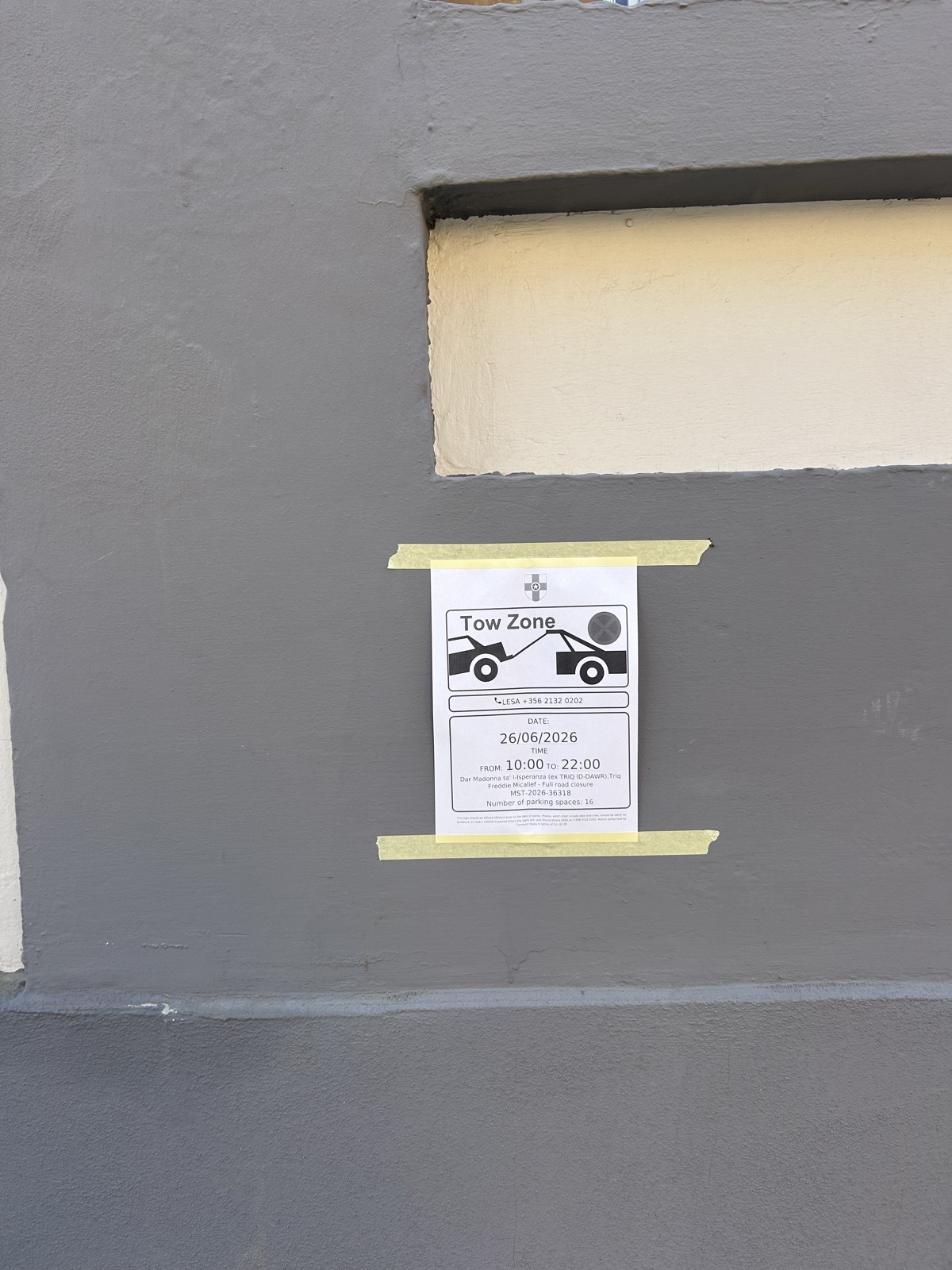
I asked LESA what mechanism they use to prove a tow zone notice was actually up when a car was parked there. The answer was tape.
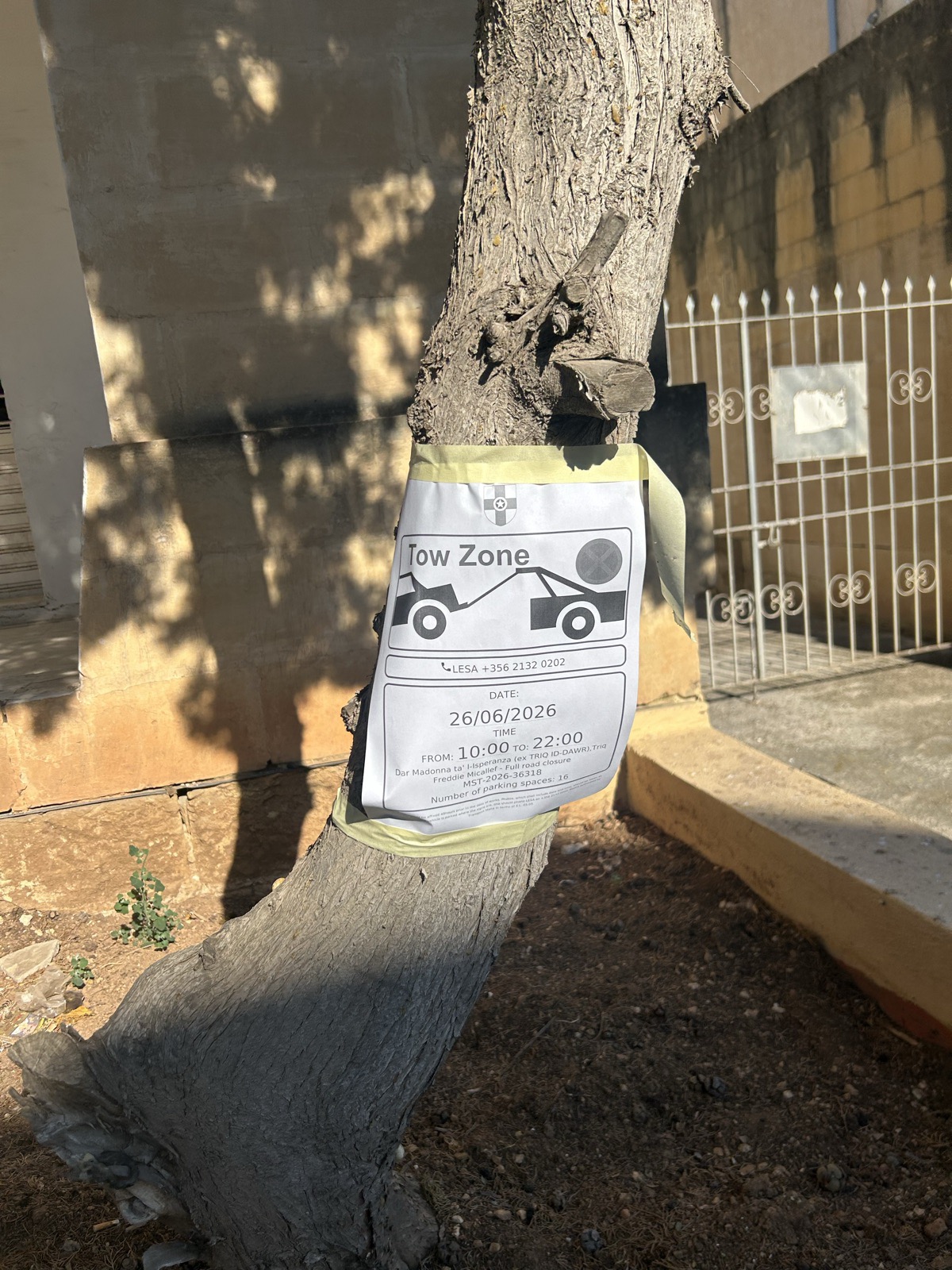
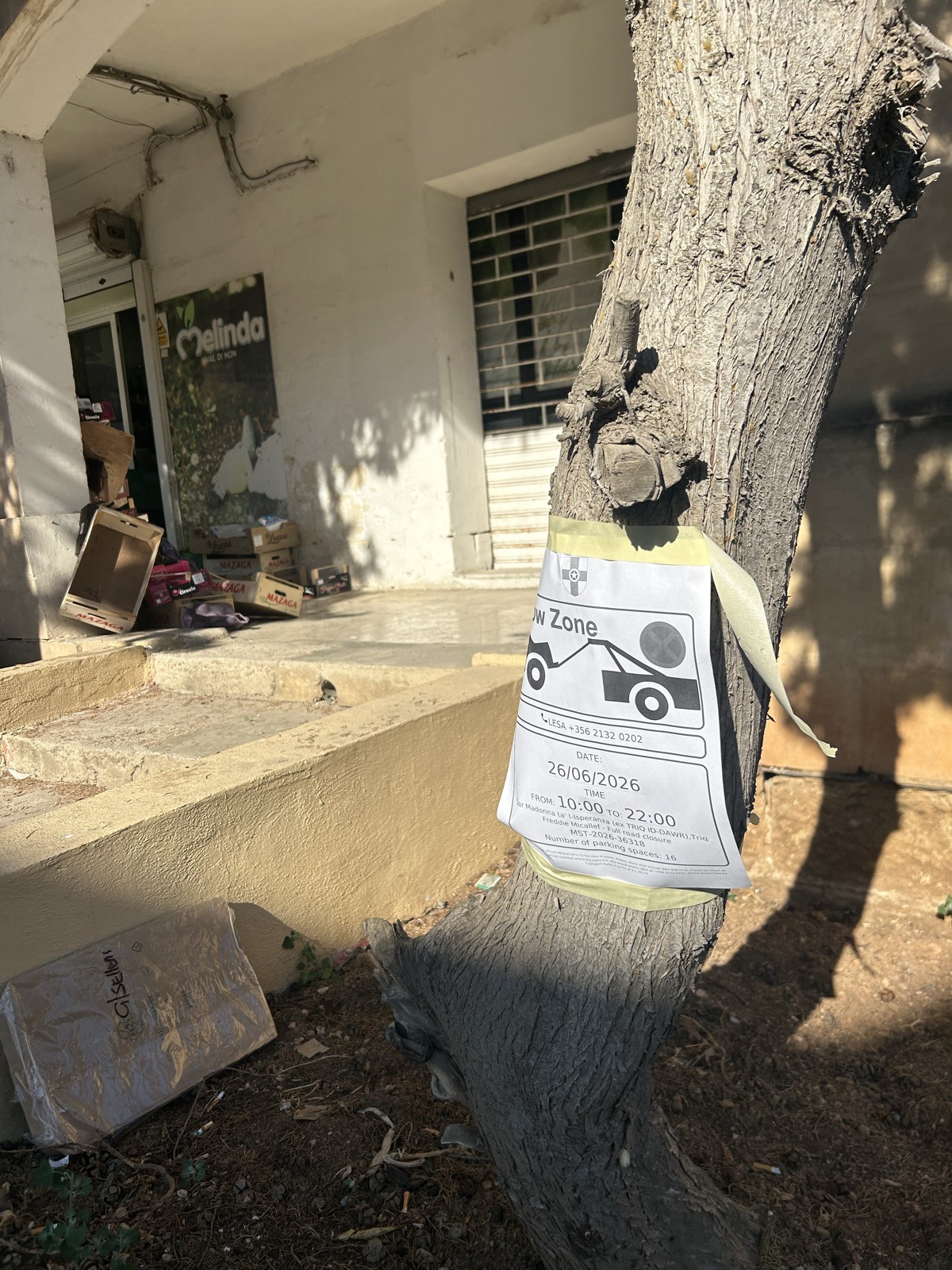
When a permit goes up, the applicant photographs the masking tape holding the notice. On tow day, they photograph it again. If the angle of the tape matches, that is treated as proof the sign was there the whole time. That is the verification system. No tamper-evident seal, no serial number, no independent witness. A strip of masking tape, on surfaces nobody controls, in Maltese summer heat, checked by the same people who issued the permit.
Look at any of these notices a few hours after they go up and the tape is already curling off the bark of a tree. A sign that was never properly secured looks exactly like a sign that fell down on its own. There is no way to tell the two apart, which means the standard for "the notice was displayed" is whatever the photographs happen to show. This is the evidence behind a legally binding enforcement decision.
The seal of authenticity
A strip of masking tape, photographed twice, is the proof your car was parked illegally.
No tamper-evident seal. No serial number. No witness. Tape on a tree, in the June heat, checked by the same people who issued the permit. This is a legally binding enforcement mechanism.
What should change
None of this is about one car. It is about a default that works against every driver in the country, and an evidence standard that would not survive five minutes of scrutiny. The fixes are cheap and obvious.
The petition
Make LESA notification opt-out, not opt-in
If you think an agency that can take your car should have to try to tell you first, add your name. Three demands:
- Notification on by default. Change the LESA notification system to opt-out for all registered vehicle owners, so contact is attempted unless a person actively declines it.
- A logged contact attempt before every tow. Require a recorded, evidenced attempt to reach the owner before a vehicle is removed, not after.
- Tamper-evident seals, not masking tape. Replace masking tape with dated, tamper-evident stickers for verifying that tow zone notices were properly displayed.